How Mobile Weighing and Wireless Label Printing Creates a Faster Point-of-Activity Workflow



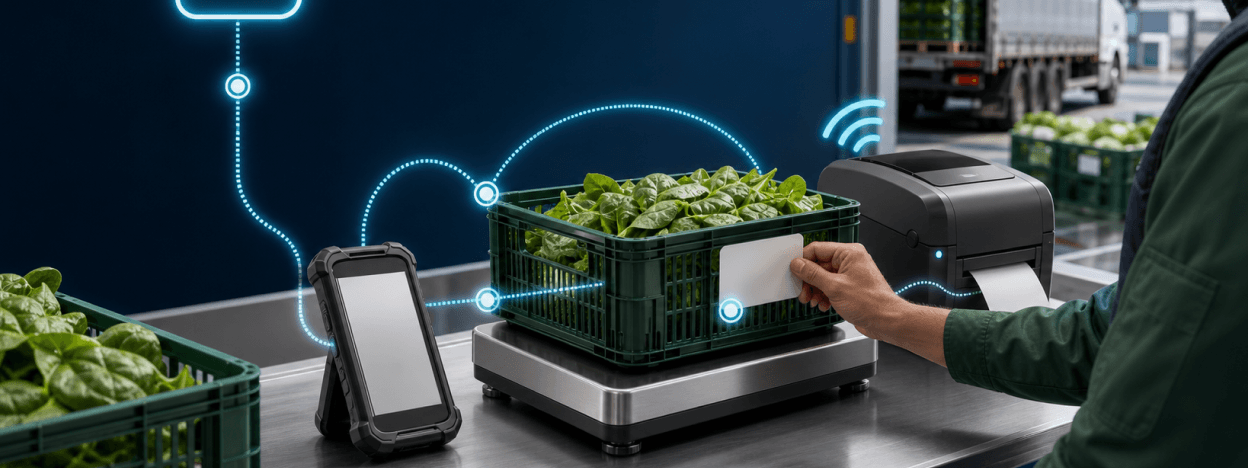
Operations lose time when weighing and labeling are separate steps. An operator captures a measurement, re-enters information into another device, selects a printer, and then tries to match the label back to the correct container or product.
We built an integrated mobile workflow that connects to weighing equipment, applies worker and task context, validates the reading, stores the event, and sends formatted output to a wireless label printer.
The result is a closed-loop process in which the physical item, its weight, its label, and its digital record are created together.
The Challenge
Manual handoffs between scales, mobile devices, and printers introduce transcription errors and mislabeled containers. Device pairing, battery condition, printer availability, and connection recovery can also interrupt production.
Teams need one operational screen that manages compatible hardware without hiding the business context required for a useful record.
Our Solution
The workflow manages Bluetooth scale discovery, stored device selection, live readings, employee and container context, and event validation. Once a record is accepted, integrated CPCL-compatible printing can produce a label or receipt over a wireless connection.
Setup screens preserve equipment preferences, while local databases and synchronization components maintain the digital history. Operators can continue working through temporary network interruptions without separating the label from the event.
The workflow is designed to make complex operational technology feel simple at the point of activity. Operators follow a clear sequence, while supervisors and system owners retain the configuration and visibility needed to manage the process at scale.
Key Features
The design incorporates functionality that helps ensure greater accuracy and easier control:
- Scanning and pairing of Bluetooth scales and management of paired devices and reconnecting them
- Display of current weight and battery or connectivity status
- Context of worker, job, list, and container
- Weight and validation based on tares
- Wireless printing using CPCL protocol to print labels and receipts
- Discovery and use of preferred printers
- Storage of events and synchronization of these events
- Summary view and administration
All of these functions contribute to establishing an efficient digital flow.
Benefits for Point-of-Activity Operations
Using a purpose-built mobile workflow provides several operational advantages:
- Reduce duplicate data entry between weighing and labeling.
- Lower the risk of labels being matched to the wrong item.
- Shorten the time from accepted weight to printed output.
- Improve resilience when network connectivity is inconsistent.
- Simplify scale and printer setup for repeat operators.
- Create a consistent digital and physical audit trail.
Rather than relying on memory, handwritten notes, or disconnected devices, teams receive a structured process that supports faster work and more dependable decisions.
Benefits for Packing and Labeling Managers
Managers overseeing weigh-and-label stations need the printed identifier to remain connected to the exact measurement and item that created it. The workflow helps them:
- Reduce mismatches between accepted weights, printed labels, and physical containers
- Standardize label output across operators, stations, products, and customers
- Review printer, scale, and connection problems that interrupt station throughput
- Control tare rules and required label fields from the same operational context
- Limit duplicate entry when weight data must appear in digital and printed records
- Preserve an audit trail linking each label-producing event to its source measurement
Managers gain faster stations, fewer identification errors, and a clearer basis for investigating mislabeled, missing, or reprinted output.
Built for Immediate Identification After Weighing
Integrated weighing and printing is intended for processes where the physical item must be identified as soon as its measurement is accepted. It can support:
- Packing lines labeling totes, cartons, or reusable containers
- Receiving stations printing identification after inbound weighing
- Batching areas producing a physical record for each completed load
- Mobile stations using paired scales and wireless industrial printers
- Operations applying tare, worker, task, or container context to labels
- Offline sites that must keep the digital event and printed output aligned
Creating the measurement, digital record, and physical label in one sequence reduces handoffs and lowers the risk that identification is attached to the wrong item.
Expanding the Closed-Loop Weigh-and-Label Process
The workflow can grow to support additional label layouts, printer command languages, scale protocols, container types, barcode formats, and customer-specific fields.
Printed output can later include traceability identifiers or handling information derived from the same validated event, without requiring duplicate operator entry. This makes the weigh-and-label station a reusable foundation for receiving, packing, batching, and outbound identification processes.
Need Weighing and Labeling to Work as One Process?
If operators re-enter scale data into a printer or manually match loose labels to containers, we can design a single controlled workflow for both actions.
We can integrate device pairing, weight validation, tare rules, label formatting, printer discovery, offline storage, and synchronization around your station layout.
The outcome is faster physical identification with a matching digital audit trail from the moment the weight is accepted.

 Facebook
 Linkedin
 Instagram
 Youtube
 X
X