How RFID Identity and Container Registration Creates a Trusted Foundation for Traceable Operations



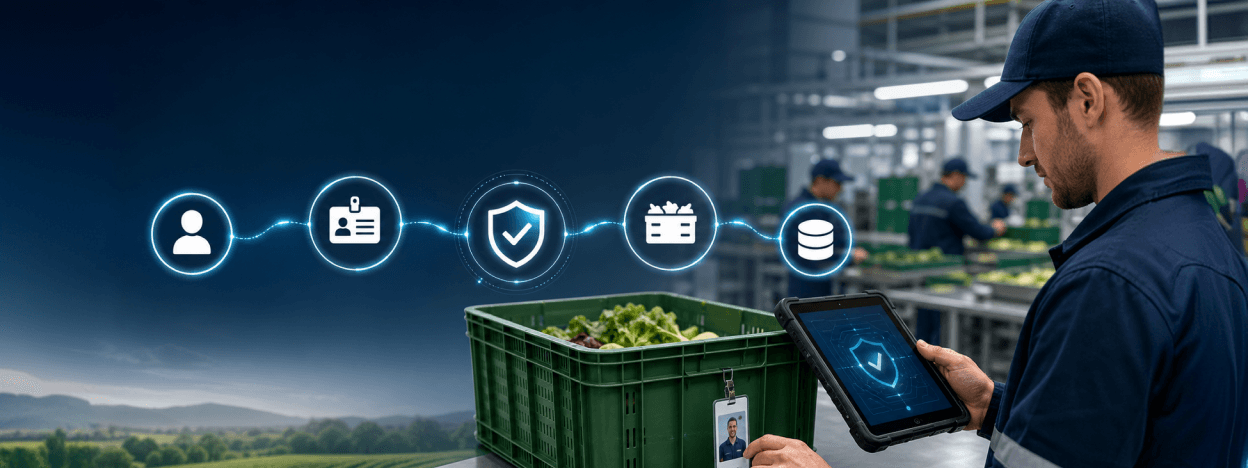
Traceability begins before the first operational scan. Employee badges, reusable containers, and security tags must be created, encoded, verified, and connected to the correct business records.
We built a dedicated registration workflow that helps authorized teams set up people and containers, program RFID or NFC media, read and erase tags, recover cards, preserve scan logs, and synchronize setup data with a central service.
By separating controlled registration from everyday field capture, organizations can improve data quality and reduce the risk of duplicate, unreadable, or incorrectly assigned identifiers.
The Challenge
When badge and container setup is handled informally, identifiers can be duplicated, assigned to the wrong record, or written with incomplete data. These errors follow the tag into payroll, production, inventory, and traceability workflows.
Registration also has to work with real hardware behavior: supported tag technologies, read/write permissions, recoverable failures, secure keys, local logs, and network-dependent synchronization.
Our Solution
The solution guides users through credential setup, initial synchronization, employee or container selection, and controlled tag programming. Dedicated read, write, erase, upload, and recovery flows make each action explicit.
Local database records preserve employees, containers, settings, scans, and diagnostic logs. Validation and security utilities help protect tag integrity, while API connectivity keeps field identities aligned with the authoritative labor and operations system.
The workflow is designed to make complex operational technology feel simple at the point of activity. Operators follow a clear sequence, while supervisors and system owners retain the configuration and visibility needed to manage the process at scale.
Key Features
This solution has a number of useful components aimed at improving accuracy of workers’ actions and making operations more manageable:
- Adding, searching, and programming employees’ badges
- Creating and assigning RFID tags to containers
- Reading, writing, erasing, uploading, and recovering tags
- Support for MIFARE-compatible NFC media
- Creating secure keys and container tags
- Local scanning history and logging
- Setting up credentials and synchronizing
- Checking network availability, status dialogs, and hardware compatibility states
All these components combined make a consistent workflow with a digital trace of every transaction.
Benefits for Operations and IT Teams
Using a purpose-built mobile workflow provides several operational advantages:
- Establish unique, consistent identifiers before field use.
- Reduce registration errors that later affect payroll or traceability.
- Give support teams a diagnostic history of tag operations.
- Control sensitive write and erase actions through explicit workflows.
- Prepare containers and employees for faster downstream scanning.
- Maintain continuity with local data while synchronizing to central records.
Rather than relying on memory, handwritten notes, or disconnected devices, teams receive a structured process that supports faster work and more dependable decisions.
Benefits for Registration Administrators and Support Teams
Administrators responsible for badges and reusable assets need confidence that each physical tag represents the correct approved record. The workflow helps them:
- Verify employee or container details before writing an RFID credential
- Prevent duplicate assignments and accidental reuse of active identifiers
- Review programming, reading, erasing, recovery, and upload activity
- Diagnose failed or damaged cards using a traceable technical history
- Apply consistent security keys and tag formats across registration stations
- Keep issued credentials aligned with authoritative labor and container records
Support teams gain a controlled process for resolving tag problems, while operations receive identities that are more dependable from their first downstream scan.
Built for Controlled RFID Issuance and Asset Setup
Registration belongs in a controlled environment where identities can be verified before tags enter daily operations. Typical deployment points include:
- Labor offices issuing employee and crew-leader badges
- Equipment rooms programming secure keys and replacement credentials
- Container depots assigning reusable assets to unique RFID identities
- Packhouses preparing tags before seasonal or site-wide deployment
- Support desks reading, diagnosing, erasing, or recovering damaged cards
- Administrative teams synchronizing approved people and container records
Separating tag issuance from routine scanning creates a clearer chain of responsibility and reduces the chance that an incorrect identifier reaches payroll, production, or inventory workflows.
Extending a Trusted Identity Foundation
The registration process can expand to new tag roles, credential policies, container types, key structures, and approval procedures without changing downstream scanning behavior.
Historical scan and programming logs can support troubleshooting, replacement audits, duplicate prevention, and tighter lifecycle management for physical credentials. A dependable issuance process becomes the identity foundation for future workforce, production, weighing, and traceability services.
Need a Dependable RFID Registration Process?
If badges or reusable-container tags are being created through informal or inconsistent procedures, we can define a controlled workflow from master-data selection through verification and programming.
We can tailor tag encoding, security keys, read-write rules, recovery procedures, local logs, and synchronization to the RFID media and backend records you already use.
The result is a supportable registration station that gives every downstream scan a more trustworthy starting point.

 Facebook
 Linkedin
 Instagram
 Youtube
 X
X