How an Agriculture Solution Operations Ecosystem Turns Physical Work Into Reliable Business Intelligence



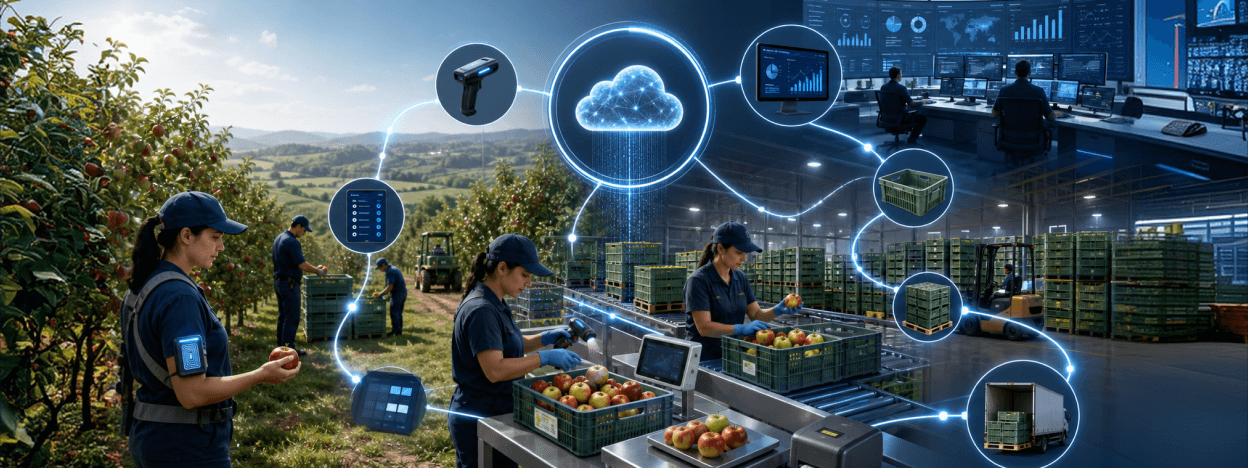
Agricultural and industrial operations still depend on physical actions: people clock in, crews select work, products are picked, loads are weighed, containers move, quality is inspected, and inventory changes hands. The challenge is not performing these actions. It is capturing each one accurately, in context, at the moment it happens.
We created a connected operations ecosystem that links workforce identity, task execution, weighing, quality control, inventory traceability, RFID setup, barcode capture, local records, printing, and cloud synchronization. Each focused mobile workflow solves a specific frontline problem while contributing to a consistent operational record.
The result is a practical digital foundation for organizations that need speed in the field, dependable traceability in the supply chain, and clearer performance information for managers.
The Challenge
Disconnected tools create gaps between physical work and business systems. A weight may be recorded without the correct employee or lot. A container could be moved without a good chain of custody. A quality defect could be observed and not associated with the product context. Paper notes and delayed spreadsheets result in re-entry, inconsistencies and lack of visibility.
Frontline environments add another constraint: connectivity is not always dependable. A useful platform must keep work moving locally, support specialized hardware, validate records before saving, and synchronize when communication is available.
Without a shared operating pattern, each process becomes an isolated data source. Management receives reports after the opportunity to correct the work has passed.
Our Solution
The ecosystem follows one repeatable operational flow: identify the person or asset, select the work context, capture the physical fact, validate the record, commit it locally, and connect it to downstream systems. That pattern is applied across labor, picking, weighing, quality, containers, orders, and inventory.
RFID and NFC support fast identity and container recognition. Barcode scanning connects items and locations. Bluetooth and USB integrations bring readings directly from weighing equipment. Local databases and event logs preserve continuity. API, file, and wireless printing capabilities move the result to the people and systems that need it.
Because each workflow is focused, operators see only the decisions required for the task at hand. Because the workflows share a common operational model, leaders gain a more coherent view of work across the business.
The workflow is designed to make complex operational technology feel simple at the point of activity. Operators follow a clear sequence, while supervisors and system owners retain the configuration and visibility needed to manage the process at scale.
Key Features
The solution provides practical capabilities to improve frontline accuracy and simplify operational control:
Frontline identity via employee badges, RFID, NFC and controlled setup
- Context selection for task, lot, variety, location, container, order and crew
- Direct capture from scales, barcode scanners, operator input and quality inspections Rules to prevent incomplete, inconsistent, negative, duplicate or out-of-sequence records
- Offline-capable local persistence with auditable event histories
- Cloud synchronization, API exchange, structured exports and operational reporting Wireless label and receipt printing at the point of activity
- Focused workflows for fast picking, workforce tracking, quality control, registration, weighing and inventory movement Collectively, these capabilities create a consistent digital workflow that reduces manual reconciliation and preserves the context behind every accepted record.
Business Outcomes Across the Ecosystem
The use of an appropriately designed mobile workflow solution can yield many operational benefits, including:
- Accuracy – recording measurements and events from where they happen rather than recreating them.
- Traceability – associating people, products, packages, locations, and transactions to create an auditable history.
- Productivity – minimizing data entry, reconfigurations, redundant navigation, and reconciliation by supervisors.
- Visibility – translating front-line activity into summary information for management decision-making.
- Quality – creating consistent inspections and retaining context about defects.
- Flexibility – configuring workflows for different facilities, activities, crops, products, equipment, and business processes.
- Instead of depending on memory and manual record keeping, a defined process is provided that helps employees work faster and make more confident decisions.
Designed for Connected Operations Across the Supply Chain
The ecosystem is most valuable where several physical workflows must contribute to one dependable operational history. It can connect activity across:
- Field crews identifying workers, tasks, lots, and harvest output
- Weigh stations connecting measurements to employees and containers
- Quality teams inspecting product against configurable defect standards
- Packhouses receiving, labeling, staging, and moving reusable containers
- Warehouses tracing inventory, locations, transfers, orders, and fulfillment
- Management systems receiving synchronized events for reporting and analysis
A shared identify-select-capture-validate-commit-connect pattern allows these workflows to remain focused while producing information that can be understood across the business.
Growing From Focused Workflows to Operational Intelligence
Organizations can begin with the process that creates the greatest operational risk, such as labor capture, weighing, quality inspection, or inventory movement, and then connect adjacent workflows in phases.
As adoption grows, shared identifiers and consistent event records create stronger foundations for cross-site reporting, performance comparison, exception detection, and end-to-end traceability.
This modular path reduces deployment risk while allowing the ecosystem to develop into a broader source of operational intelligence.
Planning a Connected Operations Ecosystem?
If your organization relies on multiple disconnected field and facility systems, we can map how people, tasks, products, containers, measurements, and quality events should connect.
Our team can design the mobile workflows, hardware integrations, offline behavior, validation rules, synchronization services, and reporting structure required for a phased transformation.
The result can start with one urgent operational problem and expand into a connected platform aligned with your equipment, sites, workforce, and long-term data strategy.

 Facebook
 Linkedin
 Instagram
 Youtube
 X
X