How Digital Harvest Weighing Connects Workers, Containers, Tasks, and Production Records



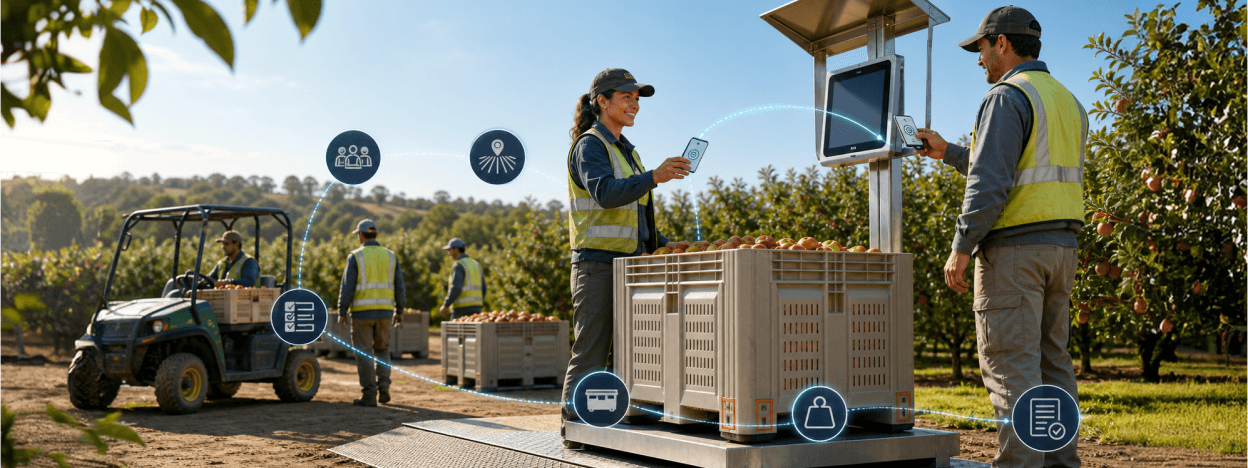
Harvest weighing is more than measuring product. Each reading must be associated with the correct worker or crew, task, field context, and container before it can support payroll, yield, and traceability.
We built a guided harvest weighing workflow that combines badge identification, task selection, container assignment, connected scale capture, validation, local records, and synchronization.
By bringing these steps together at the point of weighing, the solution reduces reconciliation and creates a cleaner production history from the first capture.
The Challenge
Disconnected scale readings and handwritten worker records make it difficult to validate production. Shared containers, tare values, task changes, and multiple employees can create ambiguity about who should receive credit and where the product originated.
Operators need a fast interface that supports real equipment and field conditions while preventing invalid or incomplete weigh events.
Our Solution
The workflow guides the operator through equipment setup, employee or crew selection, task and list context, container choice, and weight capture. NFC or connected readers can identify people and containers, while USB-compatible scale support brings the measurement directly into the event.
Validation rules check the event before it is saved. Local storage protects the record in the field, and synchronization and summaries make the information available for payroll and operational review.
The workflow is designed to make complex operational technology feel simple at the point of activity. Operators follow a clear sequence, while supervisors and system owners retain the configuration and visibility needed to manage the process at scale.
Key Features
The solution has features that enhance front-line precision as well as operational control:
- Identification of employees and crews using badges
- Selection of task, lot, variety, and customizable list
- Selection and assignment of containers
- Weighting with container tare awareness
- USB scale communication and device permissions
- Validation of production events captured
- Local storage of event histories and synchronization
- Tasks, equipment, and field rules administrative configuration
In combination, these features make up a digital workflow that enhances the process of reconciliation and retains the context of each accepted record.
Benefits for Harvest Operations
Using a purpose-built mobile workflow provides several operational advantages:
- Reduce mismatches between workers, containers, and recorded weights.
- Improve the reliability of piece-rate or weight-based compensation data.
- Capture more complete harvest context without slowing the weigh station.
- Give supervisors faster access to employee and task summaries.
- Preserve work during poor connectivity and synchronize later.
- Create stronger source data for yield, labor, and traceability analysis.
Rather than relying on memory, handwritten notes, or disconnected devices, teams receive a structured process that supports faster work and more dependable decisions.
Benefits for Harvest Managers and Payroll Teams
Harvest leaders need each measured load to connect reliably to the correct workers, containers, and field context. The workflow helps them:
- Review production credit by employee, crew, task, block, lot, or variety
- Confirm that container selection and tare rules were applied consistently
- Identify weights recorded without the required worker or harvest context
- Reduce end-of-shift reconciliation between scale records and crew notes
- Compare harvested weight across fields, crews, dates, and operating conditions
- Provide more dependable source records for compensation and yield reporting
Harvest managers receive timely production visibility, while payroll teams gain cleaner evidence for reviewing weight-based employee or crew credit.
Built for Harvest Weigh Stations and Container Accountability
Harvest weighing must operate at the meeting point between field labor, physical containers, and measured production. The workflow is suited to:
- Field-edge stations receiving full bins from orchard or vineyard crews
- Operations crediting individual workers or multiple employees for a load
- Sites using reusable containers with defined tare values
- Harvest programs requiring block, lot, variety, or task context
- Busy weigh points where invalid events must be stopped before saving
- Remote locations that need local records and later synchronization
By connecting the worker, container, task, and measurement at the scale, the workflow reduces ambiguity before the product leaves the field.
Extending Harvest Records Into Yield and Labor Insight
The process can adapt to different crops, crew structures, container capacities, tare methods, scale interfaces, and rules for sharing production credit.
Over time, captured weights can support field yield comparison, labor-cost analysis, container utilization, harvest forecasting, and source-lot traceability. This turns the weigh station from a simple measurement point into a dependable operational control point for the harvest program.
How We Can Help Improve Harvest Weighing and Attribution
If harvest weights, worker credit, and container assignments must be reconciled after the shift, we can help capture all three together while the weighing event is taking place.
How we can help: We redesign the station flow around badge identification, container selection, scale capture, tare rules, crew attribution, exception checks, and immediate confirmation for the operator.
Our expertise: We combine RFID and container identification, USB scale integration, weight and tare validation, individual or crew production credit, local storage, synchronization, and reporting to produce cleaner harvest records with less administrative correction.

 Facebook
 Linkedin
 Instagram
 Youtube
 X
X